Folgefonna National Park
Norway
Folgefonna is the ice cap on the peninsula between the Hardangerfjord and its branch the Sørfjord, in western Norway,…
3 tickets & tours
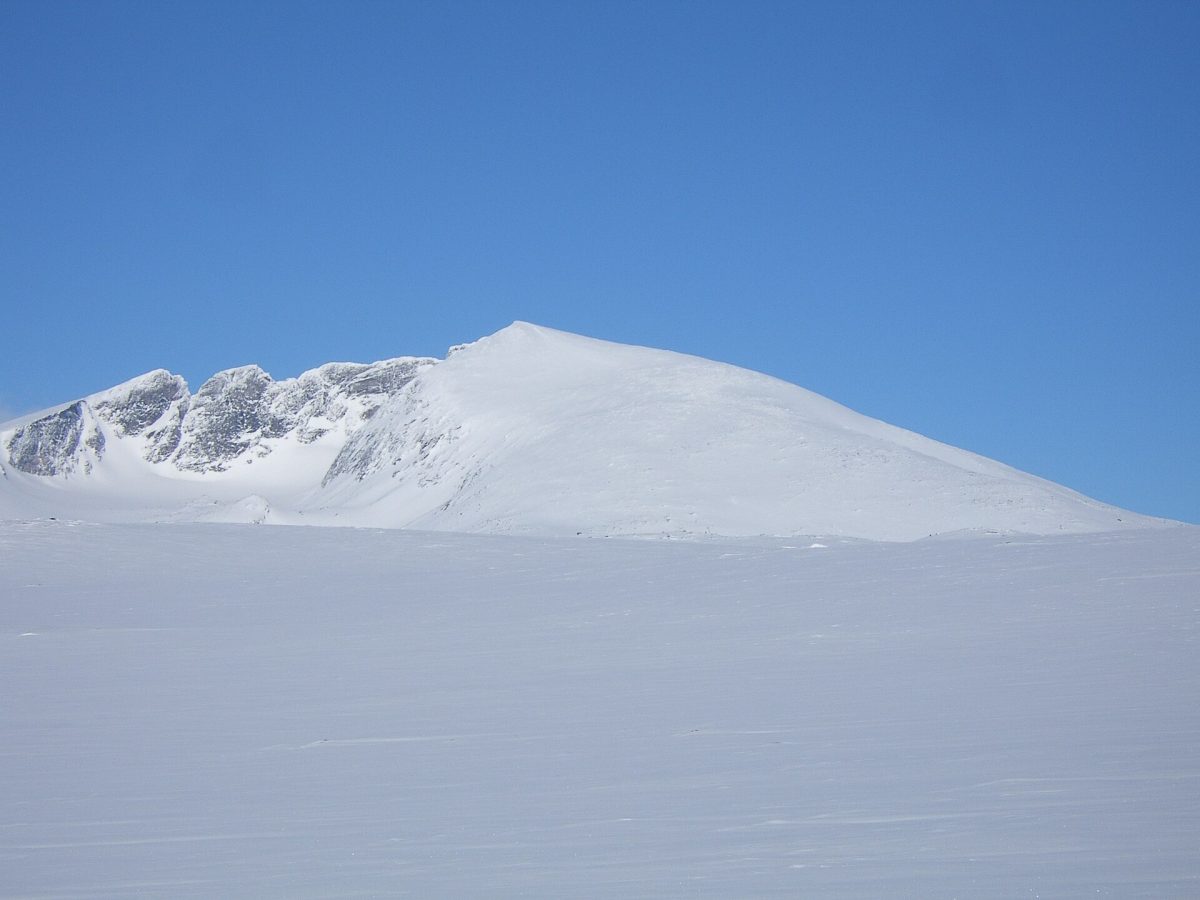
Photo: Kjetil Kjernsmo, CC BY-SA 3.0
Dovrefjell is the high mountain plateau that separates southern Norway from the Trondheim region, and it is unusually easy to reach for so wild a place, because both the main road between Oslo and Trondheim, the E6, and the Dovre railway cross it: the little station of Hjerkinn, at a thousand metres, is about four and a half hours from Oslo and two and a half from Trondheim by train, and the small towns of Dombas, to the south, and Oppdal, to the north, are the other bases. People come, above all, to see the musk ox, which lives wild nowhere else in Norway. The animals graze on the open fells east and west of the road, and they can be found independently on foot, but most visitors join a guided musk ox safari from Hjerkinn, Dombas, Kongsvoll or Oppdal, a walk of four to six hours over rough, pathless ground with a guide who knows where the herds are that day and how closely they may be approached, offered daily from June to September and, on skis or snowshoes, in winter.
The second attraction demands nothing: from a car park at Tverrfjellet, just off the E6 near Hjerkinn, a gentle gravel path of a kilometre and a half leads to the Snohetta viewpoint, a small pavilion of rusted steel and glass with a sinuous interior of carved timber and a fireplace, designed by the Norwegian architects who took the mountain's name, where one sits in shelter looking across the valley to the massif, often with musk oxen or reindeer in view through the binoculars provided. For walkers, a shuttle bus runs in summer from Hjerkinn along a road closed to private cars to the Snoheim tourist lodge, from which the ascent of Snohetta is a walk of five to six hours there and back, over boulders, without technical difficulty in good weather.
Live dates and prices from GetYourGuide. Free cancellation on most tickets.
The first Dovrefjell national park was created in 1974, with 265 square kilometres, and in 2002 it was absorbed into the far larger Dovrefjell-Sunndalsfjella park, of about 1,690 square kilometres, which with its surrounding protected landscapes forms one of the largest continuous conserved areas in mainland Norway, reaching from the dry, continental plateau in the east to the precipitous, rain-soaked fjord mountains of Sunndal in the west. Snohetta, 2,286 metres, a dark horseshoe of peaks round a small glacier, was long believed to be the highest mountain in Norway, and although it is not, no mountain means more to Norwegians: the men who drafted the constitution at Eidsvoll in 1814 swore to stand united and loyal until Dovre falls, the king's road and the pilgrim way to the shrine of St Olav at Trondheim both crossed the plateau, with mountain inns maintained by royal command since the twelfth century, two of which, Kongsvoll and Hjerkinn, still receive guests, and Ibsen placed in these mountains the hall of the mountain king in Peer Gynt. The musk ox, a shaggy survivor of the ice age, more nearly related to goats than to cattle, lived here in the last glacial period, as bones found during the building of the railway showed, and was reintroduced from East Greenland, first in 1932 and, that herd having been wiped out during the war, again between 1947 and 1953;
the population now stands at about two hundred to two hundred and fifty. A bull weighs up to four hundred kilograms, looks placid, and can charge at sixty kilometres an hour with very little warning, so that the rule is to keep at least two hundred metres away, and those who have ignored it have been injured and, in one case long ago, killed. Dovrefjell is equally important for the wild reindeer, which here are the last remnant of the original mountain reindeer of Fennoscandia, without any admixture of domestic stock, moving in herds of hundreds across the plateau and extremely shy; with the wolverine and the arctic fox, which has been bred in a station on the fell and released, the area preserves an almost complete alpine ecosystem. The lime-rich rocks of the Kongsvoll area support one of the richest mountain floras in Scandinavia, with plants that survived the ice age on nearby refuges, and a small alpine botanical garden displays them; the Fokstumyra marshes, by the railway near Dombas, protected since 1923, are a famous bird site, with cranes, ruffs, great snipe and bluethroats. For most of the twentieth century the army used the plain round Hjerkinn as a firing range; between 2006 and 2020 it was cleared of explosives, its roads and buildings removed, and the land returned to the park, the largest project of ecological restoration ever carried out in Norway.
The park is open all year. The summer season runs from mid-June to mid-September: June still has snowfields and nights without darkness, and the musk ox calves are small; July and early August are the warmest, with the alpine flowers at their best; late August and September bring autumn colours of red and gold across the tundra, clear air, the first snow on Snohetta and the musk ox rut, when the bulls crash heads. The shuttle to Snoheim and the viewpoint pavilion operate from about June to early October.
Winter is severe, with temperatures of minus twenty and below and strong wind, and is for guided trips and experienced skiers. The weather changes fast at any season, so bring windproof and waterproof clothing, hat and gloves even in July, and strong boots. Dogs must be on a lead. Allow a day, or two with Snohetta. Dombas is half an hour from Hjerkinn, Oppdal forty-five minutes, Rondane National Park just to the south-east, and Trondheim two and a half hours.
Yes. GetYourGuide lists one ticket or tour for Dovrefjell-Sunndalsfjella National Park, with live dates and prices and free cancellation on most of them.
The park is open all year.
Allow a day, or two with Snohetta.
Dovrefjell-Sunndalsfjella National Park covers 1 693 km².
Dovrefjell-Sunndalsfjella National Park was established in 1974.
Dovrefjell-Sunndalsfjella National Park is in Norway. The map on this page shows the exact spot.
Norway
Folgefonna is the ice cap on the peninsula between the Hardangerfjord and its branch the Sørfjord, in western Norway,…
3 tickets & tours
Norway
Jotunheimen, the home of the giants, is the highest mountain region of northern Europe, in the centre of southern…
1 ticket or tour
Norway
The Hardangervidda is the largest mountain plateau in northern Europe, a vast, treeless upland of rock, heather, lakes…
No online ticket
Norway
Jostedalsbreen is the largest glacier on the mainland of Europe, an ice cap more than sixty kilometres long lying on…
No online ticket
Norway
Rondane is a compact massif of high, rounded, stony mountains in the interior of southern Norway, between the long…
No online ticket