Folgefonna National Park
Norway
Folgefonna is the ice cap on the peninsula between the Hardangerfjord and its branch the Sørfjord, in western Norway,…
3 tickets & tours
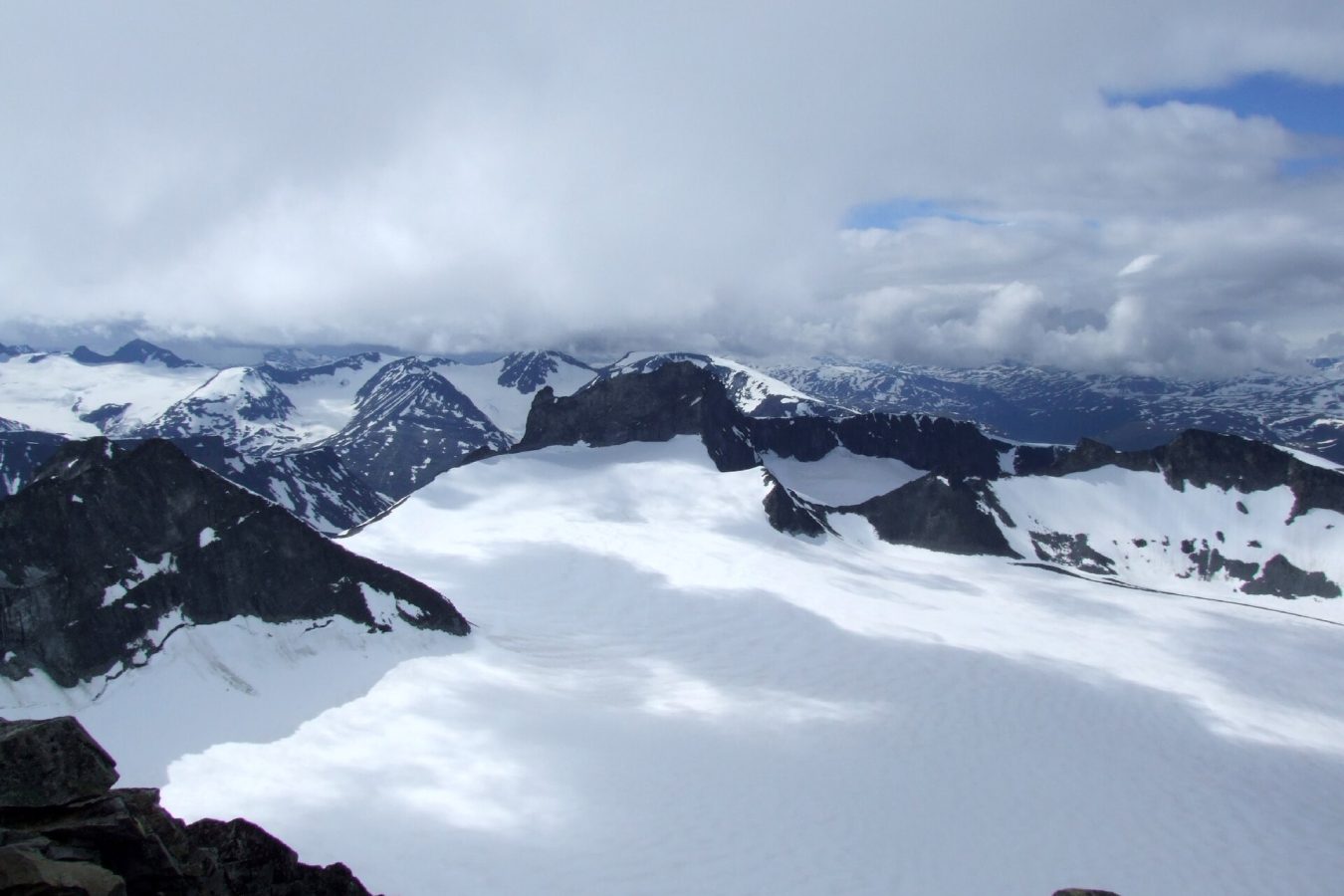
Photo: Pudelek (Marcin Szala), CC BY-SA 4.0
Jotunheimen, the home of the giants, is the highest mountain region of northern Europe, in the centre of southern Norway, and the national park at its heart is the country's premier area for mountain walking, crossed by a dense network of paths marked with red letter Ts and served by staffed lodges a day's walk apart, where one may have a bed, a three-course dinner and a packed lunch. It lies four and a half to five hours by road from Oslo, and in summer express buses run from the capital and from Bergen to the main trailheads, above all to Gjendesheim; the railway station of Otta and the village of Lom, with its medieval stave church and mountain museum, are the gateways on the north. The best-known walk in Norway is here: the Besseggen ridge.
Walkers take the early boat from Gjendesheim along the lake of Gjende to Memurubu, and walk back, fourteen kilometres in six to eight hours, climbing to a narrow, rocky crest, with some easy scrambling, between two lakes that lie side by side at different heights and of different colours, the long emerald Gjende and the dark blue Bessvatnet four hundred metres above it; some sixty thousand people do it each summer, and the boat should be booked. The second great objective is Galdhopiggen, the highest mountain in Norway, which can be climbed in two ways: from the Juvasshytta lodge, at 1,841 metres, reached by a toll road from the Lom side, with a guide, roped, across a small glacier, in five to six hours there and back, a trip that any fit person can manage; or from Spiterstulen, in the valley, by a long, steep path of 1,300 metres that avoids the ice. Guided hikes of other kinds, among them walks to look for reindeer, are offered from the surrounding valleys. Two scenic mountain roads, over Sognefjellet and Valdresflye, skirt the park.
Live dates and prices from GetYourGuide. Free cancellation on most tickets.
The national park was established in 1980 and covers 1,151 square kilometres of a larger mountain district, with the protected valley of Utladalen adjoining it on the west. More than 250 of its summits exceed 1,900 metres, among them the two highest in Scandinavia, Galdhopiggen, 2,469 metres, and Glittertind, whose cap of ice formerly made it a rival but has shrunk until the mountain stands a few metres lower. The rock is chiefly gabbro, hard, dark and rough, which gives the central peaks their sharp, alpine forms, carved by the ice into horns, knife ridges and cirques, with some sixty glaciers, deep, U-shaped valleys and long lakes coloured green by glacial silt; in the west, the Hurrungane are the wildest of all, a range of rock spires culminating in Store Skagastolstind, 2,405 metres, first climbed alone in 1876 by the Englishman William Cecil Slingsby, who is honoured as the father of Norwegian mountaineering. The name itself is a literary invention: the mountains, known to the farmers of the valleys only by local names, were called the giants' mountains by the geologist Keilhau, who explored them in 1820, and rechristened Jotunheimen in 1862 by the poet Aasmund Olavsson Vinje, after the realm of the frost giants in Norse mythology, in the years when educated Norwegians were discovering their own highlands;
Vinje was a founder of the Norwegian Trekking Association, whose cabins have served walkers here since the 1870s. Ibsen set Peer Gynt's boastful tale of a ride on a reindeer buck along a razor-edged ridge above Gjende, and the Besseggen has profited ever since. People have used these mountains for a very long time. As the ice patches melt, archaeologists have recovered from their edges thousands of objects dropped by hunters and travellers, arrows, a complete woollen tunic some seventeen hundred years old, a Bronze Age shoe, a Viking ski with its binding, and the evidence of a forgotten mountain pass at Lendbreen, used for a thousand years; at Juvflye, below Galdhopiggen, a tunnel has been cut into an ice patch six thousand years old for visitors. The valleys were the summer pastures of the farms below, and some mountain dairies still operate. Wild reindeer survive in the western part, while the herds seen in the east belong to cooperatives of farmers from Lom and Vaga; elk, red deer and roe deer live in the birch woods, wolverine and lynx are present, and golden eagles, gyrfalcons and ptarmigan breed. In Utladalen, the Vettisfossen drops 275 metres in a single leap, the highest unregulated waterfall in Norway.
The park is open all year, but the summer walking season is short, from about late June or early July to mid-September, when the staffed lodges are open and the boats on Gjende run, from mid-June to early October. Snow lies on the high paths and passes well into July, streams are high with meltwater early in the season, July and early August are the warmest and busiest weeks, when Besseggen is crowded by mid-morning, and late August and September bring stable, clear weather, autumn colours and the first snowfalls.
Weather changes fast at any time, with wind, fog and sleet possible in midsummer, so carry warm and waterproof clothing, hat, gloves, map and compass, and do not attempt Besseggen in strong wind or rain. The lodges open again for ski touring from about March to early May. The scenic roads are closed in winter. Allow three days to a week. Lom is forty-five minutes from Juvasshytta, the Sognefjord at Skjolden an hour west, and Rondane to the north-east.
Yes. GetYourGuide lists one ticket or tour for Jotunheimen National Park, with live dates and prices and free cancellation on most of them.
The park is open all year, but the summer walking season is short, from about late June or early July to mid-September, when the staffed lodges are open and the boats on Gjende run, from mid-June to early October.
Allow three days to a week.
Jotunheimen National Park covers 1 151 km².
Jotunheimen National Park was established in 1980.
Jotunheimen National Park is in Norway. The map on this page shows the exact spot.
Norway
Folgefonna is the ice cap on the peninsula between the Hardangerfjord and its branch the Sørfjord, in western Norway,…
3 tickets & tours
Norway
Dovrefjell is the high mountain plateau that separates southern Norway from the Trondheim region, and it is unusually…
1 ticket or tour
Norway
The Hardangervidda is the largest mountain plateau in northern Europe, a vast, treeless upland of rock, heather, lakes…
No online ticket
Norway
Jostedalsbreen is the largest glacier on the mainland of Europe, an ice cap more than sixty kilometres long lying on…
No online ticket
Norway
Rondane is a compact massif of high, rounded, stony mountains in the interior of southern Norway, between the long…
No online ticket