Dovrefjell-Sunndalsfjella National Park
70 km away
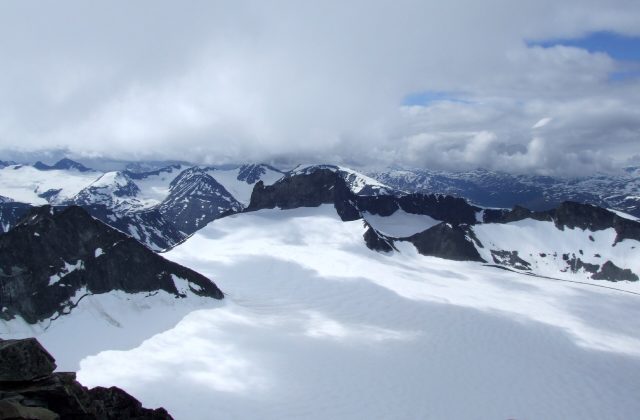
Dovrefjell is the high mountain plateau that separates southern Norway from the Trondheim region, and it is unusually…
1 ticket or tour

Photo: CC BY-SA 3.0
Rondane is a compact massif of high, rounded, stony mountains in the interior of southern Norway, between the long valleys of Gudbrandsdalen and Osterdalen, and it was the first national park to be created in the country. It is easily reached: the main E6 road and the Dovre railway from Oslo to Trondheim run up Gudbrandsdalen along its western side, and the station and small town of Otta, three and a half hours from Oslo by train, is the usual gateway, from which a bus runs in summer up to the mountain hamlet of Mysusaeter and the car park at Spranget, on the edge of the park. On the eastern side the national tourist road from Folldal to Sollia, one of the country's designated scenic routes, skirts the mountains and gives some of the finest views of them, notably from the viewing platform at Sohlbergplassen. There are no gates or fees.
The park is classic Norwegian hut-to-hut country, with paths marked by red letter Ts and three staffed lodges of the Norwegian Trekking Association inside it, Rondvassbu, Bjornhollia and Doralseter, with others just outside. From Spranget a gravel road, closed to cars, leads in six kilometres, an hour and a half on foot or half an hour by bicycle, which can be hired at the car park, to Rondvassbu, at the southern end of the narrow lake of Rondvatnet, in the heart of the massif. From there the ascent of Storronden, 2,138 metres, the easiest of the high summits, is a walk of five hours there and back, without difficulty in good weather, and that of Rondslottet, the highest, a long day; a small boat runs the length of the lake in summer, which allows a walk back along its shore or over the peaks on either side. Those who want something gentler walk on the plateau round Mysusaeter, to the viewpoint of Formokampen or to the Ula waterfalls.
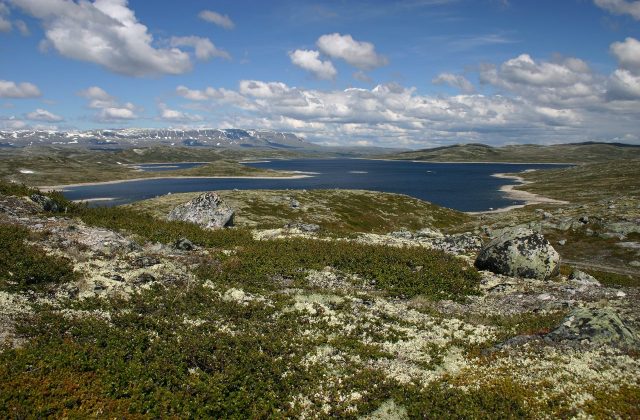
The national park was established on 21 December 1962, after a campaign of ten years led by a local man, Norman Heitkotter, and was enlarged in 2003 to 963 square kilometres, with the adjoining Dovre park to the north. It contains ten summits of more than two thousand metres, the highest being Rondslottet, the Rondane castle, 2,178 metres, grouped in three blocks divided by deep, straight valleys, that of the lake Rondvatnet cutting the massif in two like the stroke of a knife. The mountains are built of a hard, pale, flaggy sandstone, which breaks down into boulders and scree and yields a poor, dry soil, and because the massif lies in the rain shadow of the higher ranges to the west and receives only about five hundred millimetres of precipitation a year, it is a dry, bare, austere landscape, quite unlike the lush valleys of the fjord country: above the birch woods of the valley floors there is little but heather, dwarf birch, and rock covered with a pale yellow-green carpet of reindeer lichen, which gives the hills their peculiar luminous colour. The forms of the land are a textbook of the work of ice, and especially of its melting: deep cirques bitten into the peaks, some with vertical back walls of several hundred metres, dead-ice hollows, terraces left by vanished lakes, canyons cut by meltwater, and long, winding ridges of gravel, which mark the beds of rivers that flowed beneath the ice. The lichen is the winter food of the reindeer, and the park's first purpose is to protect them.
Rondane and Dovre hold one of the last herds in Europe of wild mountain reindeer of the original stock, without any admixture of domesticated animals, some two to four thousand head, descendants of those that followed the edge of the retreating ice into Scandinavia ten thousand years ago. They are extremely shy and need large undisturbed areas, and because the pressure of walkers had split the herd in two and driven it from the central part of the park, some paths have been moved and huts relocated, and walkers are asked to keep to the marked routes and to retreat if they see reindeer. Men have hunted them here for thousands of years, and the mountains are scattered with their traces, rows of stone-lined pitfall traps, some in use until the eighteenth century, stone hunting blinds for archers, and great funnel-shaped fences that guided the herds to corrals and lakes, where they were slaughtered in the Viking age and the Middle Ages. The mountains have a particular place in Norwegian culture. Ibsen's Peer Gynt, the boastful dreamer, is a man of Gudbrandsdalen, and it is in Rondane that he meets the troll king and the Boyg; a road and a walking route bear his name. The painter Harald Sohlberg spent the years from 1900 to 1914 on a single canvas, Winter Night in the Mountains, showing the blue, moonlit peaks of Rondane framed by dark trees, which hangs in the national gallery in Oslo and has been voted the national painting of Norway. Wolverines, arctic foxes, elk, roe deer, golden eagles, gyrfalcons, ptarmigan and dotterel are the other notable animals.
The park is open all year. The summer walking season runs from about late June to mid-September, when the staffed lodges are open and the boat on Rondvatnet operates; the climate being dry, the weather is more reliable here than almost anywhere else in the Norwegian mountains, and the snow clears earlier, though the summits can be hit by wind, fog and snow showers at any time. July and early August are the warmest weeks, 10 to 18 degrees, and the busiest, and from late August to mid-September the dwarf birch and bearberry turn the slopes scarlet and gold against the pale lichen, the finest time of all.
From mid-February to the end of April the lodges reopen for ski touring, and at Easter Norwegians come in large numbers; in May and early June, the calving season, parts of the park should be avoided. Bring windproof and warm clothing, a map and compass, and sturdy boots for the boulder fields. Allow two to four days. Otta is the base, the Dovrefjell park lies to the north, and the wooden town of Ringebu and its stave church an hour south.
70 km away
Dovrefjell is the high mountain plateau that separates southern Norway from the Trondheim region, and it is unusually…
1 ticket or tour
86 km away
Jotunheimen, the home of the giants, is the highest mountain region of northern Europe, in the centre of southern…
1 ticket or tour
278 km away
Folgefonna is the ice cap on the peninsula between the Hardangerfjord and its branch the Sørfjord, in western Norway,…
3 tickets & tours
No online tour for Rondane National Park is listed on GetYourGuide; entry, where it is charged, is paid at the gate or through the park authority. Nearby parks with bookable tours are listed on this page.
The park is open all year.
Allow two to four days.
Rondane National Park covers 964 km².
Rondane National Park was established in 1962.
Rondane National Park is in Norway. The map on this page shows the exact spot.
Norway
Folgefonna is the ice cap on the peninsula between the Hardangerfjord and its branch the Sørfjord, in western Norway,…
3 tickets & tours
Norway
Dovrefjell is the high mountain plateau that separates southern Norway from the Trondheim region, and it is unusually…
1 ticket or tour
Norway
Jotunheimen, the home of the giants, is the highest mountain region of northern Europe, in the centre of southern…
1 ticket or tour
Norway
The Hardangervidda is the largest mountain plateau in northern Europe, a vast, treeless upland of rock, heather, lakes…
No online ticket
Norway
Jostedalsbreen is the largest glacier on the mainland of Europe, an ice cap more than sixty kilometres long lying on…
No online ticket