Springbrook National Park
46 km away
Springbrook is a high, wet, forested plateau in the hinterland of the Gold Coast, in the south-east corner of…
1 ticket or tour
Rainforest Park · New South Wales · Australia

Photo: Paul Balfe, CC BY 2.0
Nightcap is a park of subtropical rainforest, cliffs and waterfalls in the hills behind the far north coast of New South Wales, about thirty-five kilometres north of the town of Lismore and an hour by road from the beach resort of Byron Bay, in the alternative-minded farming country round Nimbin, The Channon and Dunoon. It is reached only by car, on narrow, winding roads, the last stretches of which are unsealed and become slippery in the wet, and it is free. Its sights lie in three separate areas, approached from different directions. The most famous is Minyon Falls, on the southern escarpment, reached from the Lismore to Mullumbimby road by way of Repentance Creek: a few steps from a car park with picnic tables, a lookout platform hangs over the lip of a horseshoe of rhyolite cliffs, where a creek drops about a hundred metres into a palm-filled gorge, with a view on a clear day to the coast.
From there the Minyon Falls loop, thirteen kilometres and four to five hours, descends through eucalypt forest and rainforest to the base of the falls, where there is a pool among boulders, and climbs back, and a shorter route to the base, of about two hours each way, starts from the Minyon Grass picnic area; heavy rain and landslips have closed these tracks for long periods, and their state should be checked. Near by, the Rummery Park campground lies among tall trees. The second area, Terania Creek, at the end of a long valley road from The Channon, has a picnic ground from which an easy path of about forty minutes each way leads through magnificent rainforest, past huge buttressed trees, to Protesters Falls. The third, Mount Nardi, above Nimbin, is reached by a sealed road to a height of eight hundred metres, from which short walks lead through mossy forest to lookouts, and the long Historic Nightcap track follows the route of an old pack trail.
Live prices from GetYourGuide for tours whose route includes this park. Free cancellation on most of them.
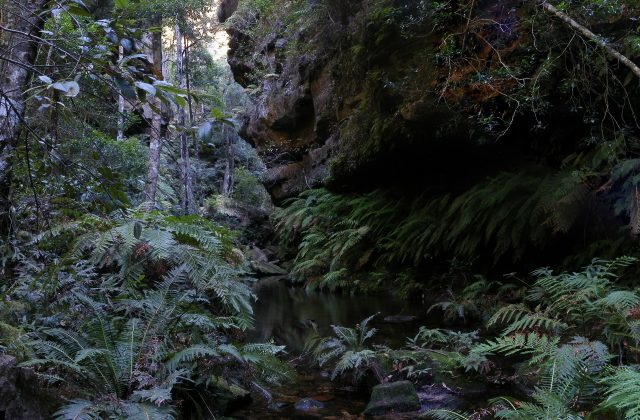
The national park was created in 1983, the date of 2016 sometimes quoted being wrong, has been enlarged to about eight thousand hectares, and since 1986 has been part of the Gondwana Rainforests of Australia, a World Heritage Site. The Nightcap range is the southern rim of the erosion caldera of the Tweed volcano, a great shield volcano that was active some twenty-three million years ago, whose central plug is Mount Warning, visible to the north, and the park's cliffs and waterfalls are cut in its lavas, the hard, pale rhyolite forming the escarpments over which the creeks fall. The rainfall is the highest in New South Wales, more than two and a half metres a year, and the deep volcanic soils support warm subtropical rainforest of great luxuriance, with red cedar, rosewood, yellow carabeen, booyong, giant stinging trees, strangler figs, bangalow palms, walking-stick palms, tree ferns and a tangle of vines, and on the poorer rhyolite soils, forests of brush box, some of whose trees have been dated at more than fifteen hundred years. This forest was once continuous with the Big Scrub, seventy-five thousand hectares of lowland rainforest on the plateau to the south, the largest in Australia, which settlers cleared almost entirely for dairy farms between the 1860s and 1900, less than one per cent surviving; the Nightcap range, too steep to farm, is the largest remnant of its upland fringe. It holds a remarkable concentration of rare and ancient plants. In 2000 a botanist, Robert Kooyman, recognised in a gully here a tree unknown to science, since named the nightcap oak, a member of the protea family whose closest relatives are known only as fossils tens of millions of years old;
fewer than three hundred mature trees exist, all within a few square kilometres, and a bushfire in November 2019, which burned into rainforest that had not known fire for thousands of years, killed a number of them. The Minyon quandong and the peach myrtle are other species confined to the range. The birds include Albert's lyrebird, found only in a small region of the border ranges, the wompoo fruit-dove, the paradise riflebird, the marbled frogmouth, the sooty owl and the rufous scrub-bird, and the mammals the red-legged pademelon, the long-nosed potoroo, the spotted-tailed quoll and the koala; Fleay's barred frog and other threatened frogs live along the streams. The park has a place in the history of Australian conservation. In August 1979, when the state forestry commission began to log the rainforest of Terania Creek, several hundred protesters, many of them settlers who had come to the district after the Aquarius festival held at Nimbin in 1973, camped in the valley and obstructed the bulldozers for a month, by sitting in the trees and in front of the machines, in what is regarded as the first direct-action blockade in defence of a forest anywhere in the world; the ensuing public debate led the state government, in 1982, to end rainforest logging in New South Wales and to create a string of new national parks, of which this was one. The country is that of the Widjabul people of the Bundjalung nation, for whom the falls and peaks are sacred.
The park is open all year, but closes in extreme fire danger and after severe storms. The waterfalls are at their best from about January to April, the wettest months, and after any heavy rain, when Minyon Falls is a thundering column; in a dry winter and spring it may shrink to a thin veil or stop altogether. The wet season is also hot, humid and leech-ridden, with the chance of flooded causeways on the access roads, which were badly damaged in the floods of 2022.
The cooler months, from May to September, give clear, mild days of 18 to 22 degrees, cold nights on the range, the best views, and the most comfortable walking. Lyrebirds sing in winter. Swimming at the base of the falls is possible but the rocks are slippery, and blue-green algae warnings are sometimes posted. Keep behind the barriers at the lookout, wear shoes with a good grip, and carry insect repellent and water. Allow a day. Nimbin is twenty minutes from Mount Nardi, The Channon, with its monthly craft market, ten from the Terania road, and Byron Bay an hour away.
46 km away
Springbrook is a high, wet, forested plateau in the hinterland of the Gold Coast, in the south-east corner of…
1 ticket or tour
50 km away
Lamington lies on a high plateau of the McPherson Range, on the border of Queensland and New South Wales, in the…
2 tickets & tours
242 km away
Noosa National Park begins where Hastings Street, the smart beachfront strip of Noosa Heads on Queensland's…
5 tickets & tours
Yes. GetYourGuide sells tickets and guided tours whose route includes Nightcap National Park; live prices are shown on this page.
The park is open all year, but closes in extreme fire danger and after severe storms.
Nightcap National Park covers 81 km².
Nightcap National Park was established in 1983.
Nightcap National Park is in New South Wales, Australia. The map on this page shows the exact spot.
New South Wales, Australia
The Blue Mountains begin about sixty kilometres west of the centre of Sydney, and their national park, a vast…
92 tickets & tours
New South Wales, Australia
Sydney Harbour National Park is not one place but a scatter of headlands, beaches and islands around Port Jackson, and…
19 tickets & tours
New South Wales, Australia
The Royal National Park lies on the southern edge of Sydney, its northern boundary only about thirty kilometres, under…
5 tickets & tours
New South Wales, Australia
Ku-ring-gai Chase is a large park of sandstone bushland and drowned river valleys on the northern edge of Sydney, only…
2 tickets & tours
New South Wales, Australia
Worimi National Park forms part of the Worimi Conservation Lands, which protect the Stockton Bight dunes, an immense…
1 ticket or tour
New South Wales, Australia
Budderoo lies on and beneath the sandstone escarpment of the Illawarra, on the south coast of New South Wales, about…
No online ticket