Pieniny National Park
Poland
Pieniny is a very small park in the far south of Poland, on the Slovak border two hours from Kraków and an hour east of…
5 tickets & tours
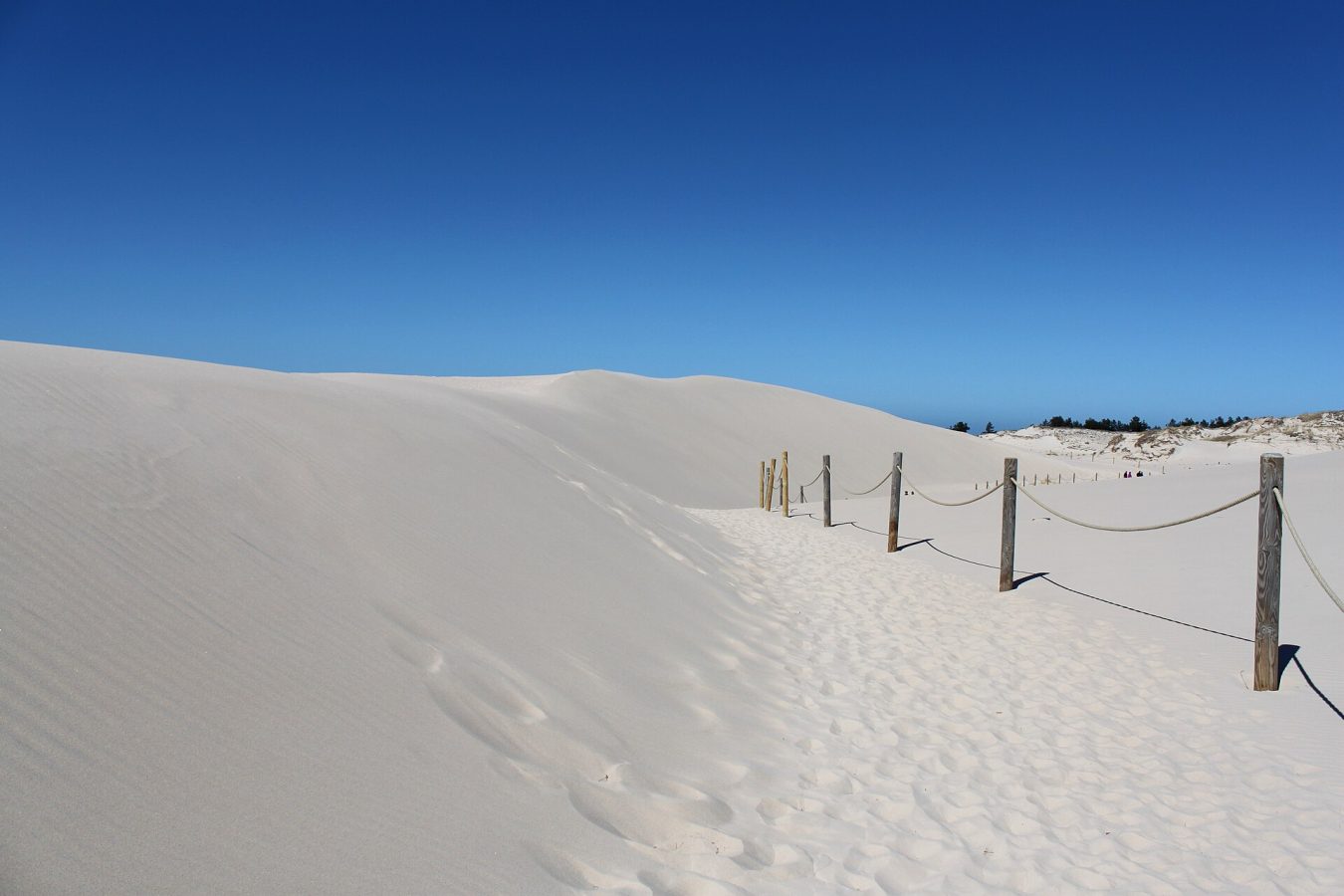
Photo: AjriszZona, CC BY 3.0
The Slowinski National Park lies on the Baltic coast of northern Poland, in Pomerania, midway between the ports of Gdansk and Szczecin, and it is known throughout the country for its moving dunes, great bare hills of white sand, the largest in Europe outside the coast of Gascony, which advance year by year across forest and lake, so that Poles call the place the Polish Sahara. The main base is the fishing port and seaside resort of Leba, at the park's eastern end, about a hundred kilometres, an hour and a half by road, north-west of Gdansk and its airport, with trains from Gdynia in summer; the quieter villages of Smoldzino, Kluki and Rowy serve the western part. Entrance tickets, which are inexpensive, are bought at the gates.
To reach the dunes one drives or takes a bus two kilometres west of Leba to the car park at Rabka, where the park gate stands, and from there a narrow forest road, closed to private cars, runs for five and a half kilometres along the shore of the Lebsko lagoon to the foot of the Lacka dune: this can be covered on foot, in an hour and a quarter, by hired bicycle, which is the most popular way, by electric cart, or by a small boat across the lagoon. From the end of the road a sandy path climbs in ten minutes on to the dune, from the crest of which the view takes in the sea on one side, the vast lagoon on the other, and a desert of sand between, and one can walk on across the dunes to the beach and return along the shore, a circuit of some fourteen kilometres in all. On the way, at Rabka, a small museum occupies the site of a German rocket testing ground. In the west of the park, the lighthouse of Czolpino stands on a wooded dune, with a path to a second dune field and the beach, the hill of Rowokol gives a view over everything from a tower, and the open-air museum of the Slovincian village at Kluki is the cultural sight.
Live dates and prices from GetYourGuide. Free cancellation on most tickets.
The national park was created in 1967, covers 327 square kilometres, more than half of which is water, and has been a UNESCO biosphere reserve since 1977 and a Ramsar wetland since 1995; it is not a World Heritage Site, though it has sometimes been proposed as one. It occupies a stretch of thirty-three kilometres of coast where, some five thousand years ago, a wide, shallow bay of the Baltic was gradually cut off from the sea by a spit of sand built up by the waves and currents, to form two large lagoons, Lebsko, the third largest lake in Poland, seventy-one square kilometres in extent and nowhere more than about six metres deep, and Gardno, with two smaller ones, fresh or slightly brackish, fringed with immense reed beds, fens, wet meadows and alder swamp. The spit itself, up to two kilometres wide, carries the dunes. The strong prevailing winds from the west and north-west pick up the dry sand of the broad beach and drive it inland, and where the forest that once held the sand was destroyed, by cutting, grazing and fires from the Middle Ages onwards, it piled up into barchans, crescent-shaped moving dunes, entirely bare, thirty to more than forty metres high, the Lacka dune being about forty-two. They travel eastwards at between three and ten metres a year, burying the pine forest in their path, whose dead trunks emerge again, bleached and sandblasted, on the windward side decades later, and gradually filling the lagoon;
in the eighteenth century they overwhelmed the old village of Leba, whose ruined church wall still stands in the woods west of the present town. Between the ridges lie damp hollows with their own flora of sundews and clubmosses, and on the older, stabilised dunes grows a fragrant forest of pine with crowberry, which turns to bog forest in the wet ground. The lagoons and marshes are one of the most important bird areas of the southern Baltic, used by more than 260 species, of which the white-tailed eagle, the eagle owl, the crane, the black stork, the bittern, the ruff and thousands of migrating and wintering geese, ducks and swans are the most notable, and elk, red deer, wild boar, otters and, offshore, grey seals are also seen. The park takes its name from the Slovincians, a small Slavic people, a branch of the Kashubians, Lutheran in religion, who lived as fishermen and peat cutters in the villages round the lagoons, speaking a language of their own; regarded as Germans by the Poles who arrived in 1945 and as Slavs by no one, they were driven to emigrate to West Germany, and their language is extinct, but their half-timbered cottages, boats, tools and the curious wooden clogs with which their horses crossed the bogs are preserved at Kluki. At Rabka, from 1940, German engineers tested anti-aircraft and long-range rockets among the dunes, and a museum displays the remains of the launch site.
The park is open all year, from early morning until dusk. July and August are the warmest months, 18 to 23 degrees, with the sea at 17 to 19 degrees, and they are the Polish holiday season, when Leba is packed, the road to the Lacka dune carries a constant stream of cyclists and carts, and the dune itself is dotted with people by midday, so that the early morning or the evening, when the low light picks out the ripples in the sand, is much the best time. May, June and September are quieter and often just as fine.
For birds, April and May and again from September to November, during the migrations, are the seasons, with thousands of cranes and geese on the lagoons in autumn. Winter is cold, grey and windy, with the dunes sometimes streaked with snow and entirely deserted. The sand is hot underfoot in summer and the glare strong, there is no shade or water on the dunes, and in windy weather the blowing sand stings. Keep to the marked routes, since the hollows between the dunes are protected. Allow a day. Gdansk is an hour and a half away, and the Kashubian lake district an hour to the south.
Yes. GetYourGuide lists 2 tickets and tours for Slowinski National Park, with live dates and prices and free cancellation on most of them.
The park is open all year, from early morning until dusk.
Slowinski National Park covers 327 km².
Slowinski National Park was established in 1967.
Slowinski National Park is in Poland. The map on this page shows the exact spot.
Poland
Pieniny is a very small park in the far south of Poland, on the Slovak border two hours from Kraków and an hour east of…
5 tickets & tours
Poland
Białowieża is the last large remnant of the primeval lowland forest that once covered the European plain, on…
3 tickets & tours
Poland
Wolin is the largest island of Poland, lying in the far north-western corner of the country between the Baltic and the…
1 ticket or tour
Poland
The Biebrza marshes lie in the north-east of Poland, in the region of Podlasie, along a lazy, unregulated river that…
No online ticket
Poland
The Bieszczady are the wildest and emptiest mountains in Poland, in the extreme south-eastern corner of the country,…
No online ticket
Poland
The Karkonosze, called the Giant Mountains in English, the Krkonose in Czech and the Riesengebirge in German, are the…
No online ticket