Pieniny National Park
170 km away
Pieniny is a very small park in the far south of Poland, on the Slovak border two hours from Kraków and an hour east of…
5 tickets & tours
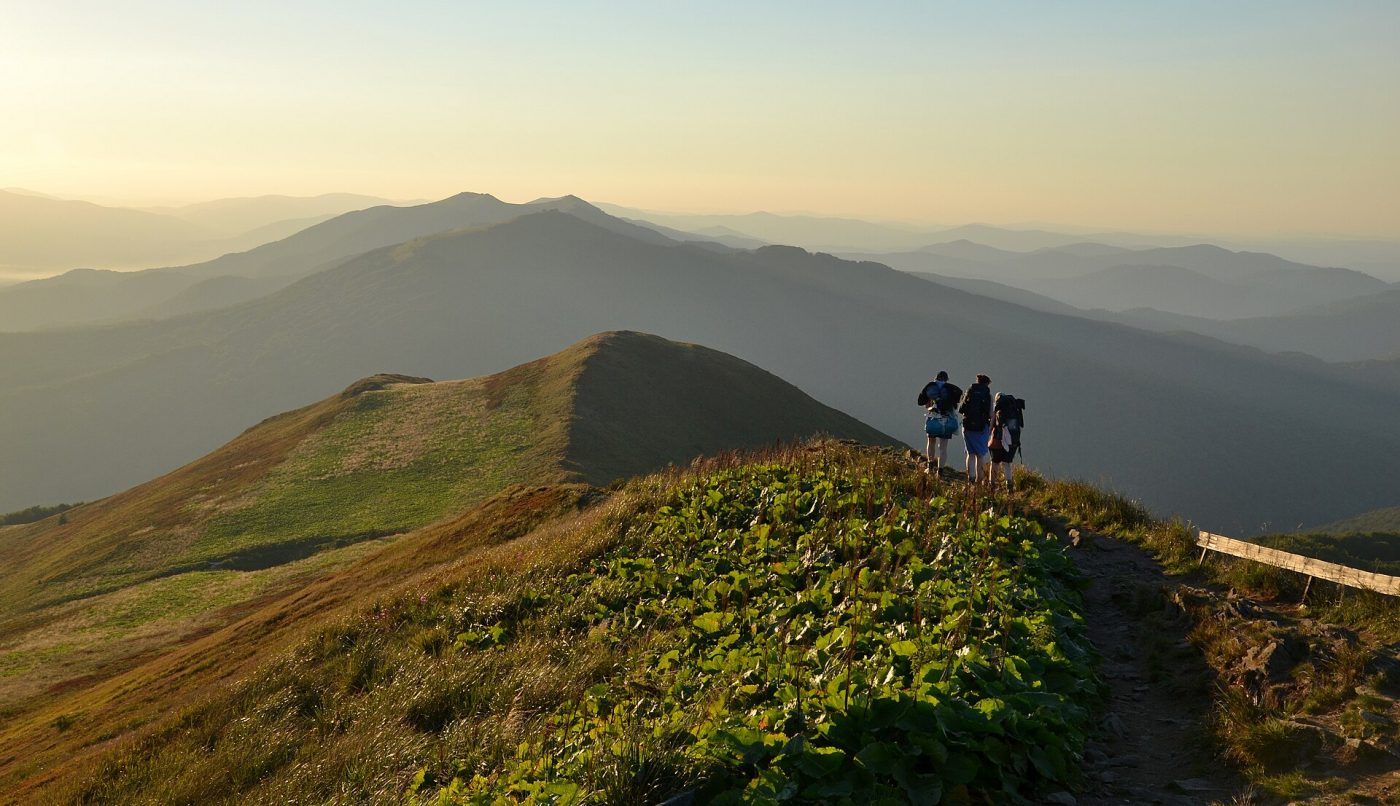
Photo: Pudelek, CC BY-SA 4.0
The Bieszczady are the wildest and emptiest mountains in Poland, in the extreme south-eastern corner of the country, wedged between Slovakia and Ukraine, and they hold a place in the Polish imagination as the land to which one escapes, a popular saying speaking of dropping everything and leaving for the Bieszczady. They are a long way from the cities, four and a half to five hours by road from Krakow and three from Rzeszow, the nearest airport, and buses beyond the towns of Sanok and Ustrzyki Dolne are infrequent, so that a car is the practical means. The national park occupies the highest part of the range, and its two bases are the small villages of Ustrzyki Gorne and Wetlina, on the one road that loops through the mountains, where there are guesthouses, hostels, campsites and simple restaurants. Entry to the trails is by ticket, sold at booths at the trailheads and online for a small sum.
The walking is superb and not difficult, on well-marked paths colour-coded in the Polish manner, climbing for an hour or two through beech forest and emerging on long, bare, grassy ridges with views for fifty kilometres in every direction. The three classic outings are the ascent of Tarnica, the highest summit, from the hamlet of Wolosate, the last in Poland, two to two and a half hours up, often continued along the ridge by Halicz and Rozsypaniec in a circuit of seven or eight hours; the traverse of the Polonina Carynska between Ustrzyki Gorne and the Wyzna pass or Brzegi Gorne; and the Polonina Wetlinska, reached in an hour and a quarter from the Wyzna pass, with its rebuilt mountain hut on the crest. In the abandoned valleys, marked historical paths lead past the remains of vanished villages. At Wolosate the park breeds Hucul mountain ponies, on which rides are offered.
The national park was established in 1973 and enlarged several times to 292 square kilometres; in 1992 it became part of the East Carpathians biosphere reserve, the first in the world to be shared by three countries, and in 2021 its old beech forests were added to the World Heritage Site of the ancient and primeval beech forests of the Carpathians and other regions of Europe. The mountains are of soft flysch, sandstone and shale, forming parallel ridges that rise to 1,346 metres at Tarnica, and their vegetation is peculiar in lacking the belts of spruce and dwarf pine found elsewhere in the Carpathians: the beech forest, with sycamore and fir, climbs unbroken to about 1,150 metres, where it gives way abruptly, in a fringe of crooked, stunted trees, to the poloniny, high grasslands of tall grasses, bilberry and eastern Carpathian herbs, which turn russet, gold and crimson in autumn. The emptiness of these mountains is not natural but the result of a catastrophe. Until the Second World War the valleys were densely settled by Boykos and Lemkos, Ukrainian-speaking highlanders of the Greek Catholic and Orthodox faith, who farmed the valley floors and grazed the poloniny. After 1944 the region became a battleground between the Polish communist state and the Ukrainian Insurgent Army, and between 1944 and 1947 the entire population was removed, first to Soviet Ukraine and then, in the operation called Vistula in the spring of 1947, scattered across the territories Poland had gained from Germany in the north and west;
the villages, more than a hundred of them, were burned or left to collapse, and their wooden churches mostly destroyed. For years nobody lived here at all. What the walker finds today in the valleys of the upper San, at Beniowa, Sianki, Bukowiec and Carynskie, are rows of old lime and ash trees marking a village street, wild fruit trees, the stone footings of a church, a cemetery with leaning crosses inscribed in Cyrillic, and cellars under the turf. Into this vacuum the forest and the animals returned, and the Bieszczady now hold the fullest assembly of large mammals in Poland: most of the country's brown bears, well over a hundred, wolves in numerous packs, lynx, wildcats, red deer, whose rut in September draws listeners from all over the country, and the European bison, reintroduced in 1963, of which several hundred of the mountain line live free in the region. Golden eagles, lesser spotted eagles, Ural and eagle owls, the black stork, the white-backed and three-toed woodpeckers, the Aesculapian snake, at the northern edge of its range, and the Carpathian newt are also present. The park is one of the darkest places in Europe at night, and has been declared a dark sky park.
The park is open all year. The finest season is the autumn, from mid-September to mid-October, when the beech forests turn copper and gold beneath poloniny of deep red, the stags roar in the valleys, the air is clear and the crowds have gone. Summer, from June to August, is warm, 18 to 24 degrees, with violent thunderstorms, which are dangerous on the exposed ridges, and July and August weekends bring queues on the path to Tarnica; May and June are fresh and flowery, with snow lingering in hollows into May.
Winter, from December to March, brings deep snow, severe frost, a risk of avalanches on some slopes, and the mountains almost to oneself, for ski tourers and snowshoers with experience. Carry waterproofs, warm clothing and water, since there is none on the ridges, keep to the marked trails, which is obligatory, and keep a clean camp, as this is bear country. Allow three days. The Solina reservoir is an hour from Ustrzyki Gorne, the narrow-gauge forest railway at Majdan near Cisna half an hour from Wetlina, and the open-air museum of Sanok two hours.
170 km away
Pieniny is a very small park in the far south of Poland, on the Slovak border two hours from Kraków and an hour east of…
5 tickets & tours
202 km away
The Hortobagy is the great treeless plain of eastern Hungary, the puszta of song and legend, and its national park lies…
1 ticket or tour
No online tour for Bieszczady National Park is listed on GetYourGuide; entry, where it is charged, is paid at the gate or through the park authority. Nearby parks with bookable tours are listed on this page.
The park is open all year.
Bieszczady National Park covers 292 km².
Bieszczady National Park was established in 1973.
Bieszczady National Park is in Poland. The map on this page shows the exact spot.
Poland
Pieniny is a very small park in the far south of Poland, on the Slovak border two hours from Kraków and an hour east of…
5 tickets & tours
Poland
Białowieża is the last large remnant of the primeval lowland forest that once covered the European plain, on…
3 tickets & tours
Poland
The Slowinski National Park lies on the Baltic coast of northern Poland, in Pomerania, midway between the ports of…
2 tickets & tours
Poland
Wolin is the largest island of Poland, lying in the far north-western corner of the country between the Baltic and the…
1 ticket or tour
Poland
The Biebrza marshes lie in the north-east of Poland, in the region of Podlasie, along a lazy, unregulated river that…
No online ticket
Poland
The Karkonosze, called the Giant Mountains in English, the Krkonose in Czech and the Riesengebirge in German, are the…
No online ticket