Białowieża National Park
112 km away
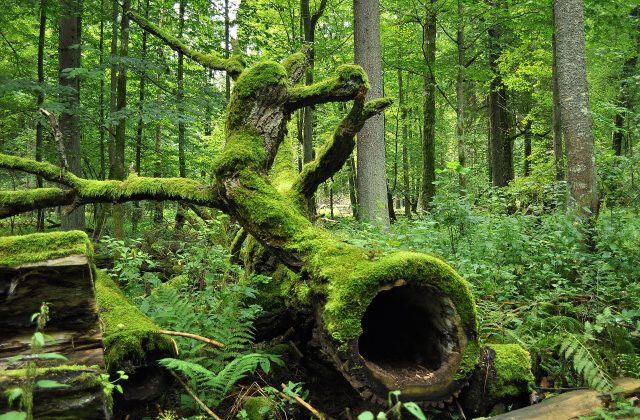
Białowieża is the last large remnant of the primeval lowland forest that once covered the European plain, on…
3 tickets & tours

Photo: Wojsyl, CC BY-SA 3.0
The Biebrza marshes lie in the north-east of Poland, in the region of Podlasie, along a lazy, unregulated river that winds for more than a hundred and fifty kilometres through a broad, flat valley of fens, reed beds, wet meadows and alder swamps, and they form the largest national park in the country and one of the most important wetlands in Europe, above all for birds. The park is about two hundred kilometres, two and a half to three hours by road, from Warsaw, and fifty from the regional capital Bialystok; its headquarters and visitor centre are at Osowiec-Twierdza, which has a station on the railway from Bialystok to Elk, but the viewing points are scattered over a very large area, and a car, or a bicycle for the stronger, is really necessary. A small entrance fee is charged, paid online or at the centre, where maps are sold and licensed local guides can be engaged, which for birdwatchers in spring is money well spent.
The valley is seen from a series of towers, platforms and boardwalks at its edges. In the southern basin, the largest and wildest, the essential places are the viewpoint of Burzyn, on a bluff above the flooded meadows; the village of Brzostowo, where cows swim the river to their pasture and the spring floods lap the farmyards; the Tsar's Road, a straight, raised road of thirty-three kilometres through the heart of the marshes, along which elk are met at dawn and dusk; and, off it, the boardwalk of Dluga Luka, four hundred metres out into the open sedge fen, and the long dyke of Honczarowska Grobla. Around Osowiec there are towers, a boardwalk and the tsarist fortress. The river can be travelled by kayak, or on a slow wooden raft with a cabin, for a day or a week, camping at riverside sites, with permits from the park.
The national park was created in 1993 and covers 592 square kilometres, surrounded by a large buffer zone, and was listed under the Ramsar convention in 1995. Its value lies in the fact that the Biebrza valley is the most extensive and the least altered complex of lowland fens left in central and western Europe, where such mires have almost everywhere been drained for farming: a bed of peat, up to several metres thick, fed by groundwater seeping from the valley sides, across which the river meanders freely with countless oxbows, flooding in spring over a width of a kilometre or more to form a temporary lake that lasts for weeks. The valley shows, in cross-section, a textbook sequence of zones, from the reed and sedge swamps beside the river, through open sedge and moss fens, to wooded swamps of alder and birch at the margins. For centuries the local farmers mowed the fens by hand for hay and litter, carrying the crop out in winter over the ice, and it was their scythes that kept the mires open; when this ceased in the second half of the twentieth century, willow, birch and reed began to overrun them, and the park now mows several thousand hectares a year with machines on wide tracks developed from snow groomers, and holds each September a championship of scything for the marshes. The open fens are the world's most important breeding ground within the European Union of the aquatic warbler, a small, streaked, buff songbird, the rarest migrant songbird of the continent, of which some two and a half thousand males sing here, about a fifth of the global population;
it is watched from the Dluga Luka boardwalk towards sunset in May and June. The park is equally known for the great snipe, which displays at dusk on traditional leks; for the ruff, the park's emblem, whose males, in ruffs of every colour, joust on the flooded meadows in April; for the greater spotted eagle, which breeds almost nowhere else in the Union; and for white-winged, black and whiskered terns, cranes, black storks, corncrakes, bitterns, spotted crakes, eagle owls and white-tailed eagles, some 270 species having been recorded. In March and April the floods are covered with tens of thousands of white-fronted and bean geese, wigeon, pintail and other duck on their way to the Arctic. The elk, the European moose, which had been exterminated in the rest of Poland, survived the Second World War only in these marshes, in the Red Bog, a strict reserve since 1925, and the country's whole population descends from that handful; there are now many hundreds in the valley. Wolves, beavers, otters and a few lynx are present. The fortress of Osowiec, built by the Russian empire from 1882 to guard the one firm crossing of the marshes, withstood German sieges in 1914 and 1915, including a chlorine gas attack on 6 August 1915 after which the dying defenders counter-attacked, an episode remembered as the attack of the dead men. In April 2020 a fire burned more than five thousand hectares of the dry marshes.
The park is open all year. For birdwatchers the season begins with the floods and the geese, from mid-March to mid-April, continues with the ruffs and the arrival of the breeding species in the second half of April, and reaches its peak from the last days of April to the end of May, when everything is singing and displaying, the great snipe and the aquatic warbler included, and when guides and rooms in the villages should be booked well ahead.
From June to August the marshes are lush, hot and afflicted with mosquitoes and horseflies in numbers that must be experienced to be believed, so that repellent, long clothing and a head net are needed, though this is the best time for kayaking. September brings the rut of the elk, flocks of cranes and the autumn colours; winter is cold, snowy and still, with elk easy to see against the snow. Bring rubber boots in spring, and binoculars and a telescope. Allow two to three days. Tykocin, with its baroque synagogue, is half an hour from the southern basin, the Narew National Park forty-five minutes, and Bialowieza two hours.
112 km away
Białowieża is the last large remnant of the primeval lowland forest that once covered the European plain, on…
3 tickets & tours
198 km away
Trakai is a small town on a narrow peninsula among lakes, twenty-eight kilometres west of Vilnius, the capital of…
1 ticket or tour
291 km away
Zemaitija National Park lies in the hilly lake country of Samogitia, the north-western region of Lithuania, about…
2 tickets & tours
No online tour for Biebrza National Park is listed on GetYourGuide; entry, where it is charged, is paid at the gate or through the park authority. Nearby parks with bookable tours are listed on this page.
A small entrance fee is charged, paid online or at the centre, where maps are sold and licensed local guides can be engaged, which for birdwatchers in spring is money well spent.
The park is open all year.
Allow two to three days.
From June to August the marshes are lush, hot and afflicted with mosquitoes and horseflies in numbers that must be experienced to be believed, so that repellent, long clothing and a head net are needed, though this is the best time for kayaking.
Biebrza National Park covers 592 km².
Biebrza National Park was established in 1993.
Biebrza National Park is in Poland. The map on this page shows the exact spot.
Poland
Pieniny is a very small park in the far south of Poland, on the Slovak border two hours from Kraków and an hour east of…
5 tickets & tours
Poland
Białowieża is the last large remnant of the primeval lowland forest that once covered the European plain, on…
3 tickets & tours
Poland
The Slowinski National Park lies on the Baltic coast of northern Poland, in Pomerania, midway between the ports of…
2 tickets & tours
Poland
Wolin is the largest island of Poland, lying in the far north-western corner of the country between the Baltic and the…
1 ticket or tour
Poland
The Bieszczady are the wildest and emptiest mountains in Poland, in the extreme south-eastern corner of the country,…
No online ticket
Poland
The Karkonosze, called the Giant Mountains in English, the Krkonose in Czech and the Riesengebirge in German, are the…
No online ticket