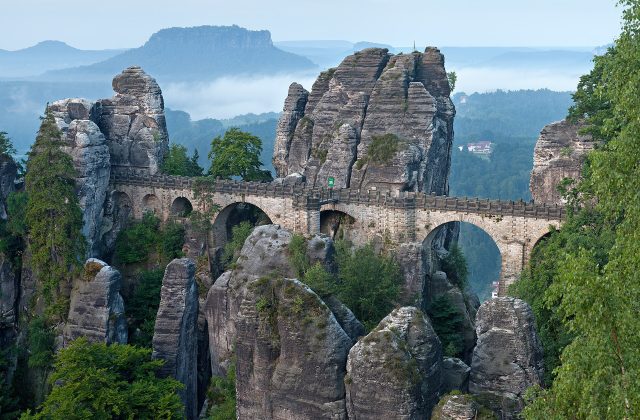
Bohemian Switzerland National Park
89 km away
Bohemian Switzerland is the sandstone park on the Czech–German border north of Prague, an hour and a half from the…
16 tickets & tours

Photo: Derbeth, CC BY 2.5
The Karkonosze, called the Giant Mountains in English, the Krkonose in Czech and the Riesengebirge in German, are the highest range of the Sudetes, on the border of Poland and the Czech Republic, and the Polish national park protects the northern side of the main ridge, above the two resort towns of Karpacz and Szklarska Poreba. They lie about two hours by road or train from Wroclaw, two and a half from Prague, and twenty minutes from the town of Jelenia Gora, and both resorts have every kind of accommodation. Entry to the park is by ticket, sold for a small sum at booths on the main trails and online. The great objective is Sniezka, the highest summit, which most people reach from Karpacz, either by the chairlift to Kopa, at 1,377 metres, followed by an hour's walk, or on foot all the way, three to four hours, by one of several marked trails, the finest of which goes by the mountain huts of Samotnia and Strzecha Akademicka and the lake of Maly Staw.
At the lower end of Karpacz stands the Wang church, which has its own ticket. From Szklarska Poreba, a chairlift climbs to Szrenica, from which the ridge path leads eastwards along the edge of the Sniezne Kotly, two great glacial cirques with cliffs of two hundred metres, and the waterfalls of Kamienczyk and Szklarka are short walks from the road, the former seen from a metal gallery in a narrow gorge, for which helmets are issued. The classic long walk is the traverse of the whole ridge, some thirty kilometres along the frontier by the Friendship Trail, from Szrenica to Sniezka, which is done in one long day or, better, two, with a night in one of the old mountain huts on either side of the border; one may cross freely into the adjoining Czech national park.
Live prices from GetYourGuide for tours whose route includes this park. Free cancellation on most of them.
The Polish national park was created in 1959 and covers about 59 square kilometres, a narrow strip along the ridge and its northern cirques; the much larger Czech park adjoins it on the south, and since 1992 the two have formed a cross-border biosphere reserve. The range is a block of granite, some 300 million years old, with a broad, gently rounded crest at 1,300 to 1,500 metres, from which the dark cone of Sniezka, of harder metamorphic rock, rises to 1,603 metres, the highest point of the Czech Republic and of the whole arc of mountains between the Alps and Scandinavia. Though modest in height, the Karkonosze stand far to the north and catch the full force of the Atlantic winds, so that the climate of their summits resembles that of mountains a thousand metres higher in the Alps: the tree line lies at only 1,250 metres, Sniezka is wrapped in cloud on nearly three hundred days of the year, winds of more than two hundred kilometres an hour have been recorded, and snow lies for six or seven months. The summit plateau is a fragment of arctic tundra, with peat bogs, dwarf pine, patterned ground formed by frost, and plants left over from the ice age, such as the cloudberry and a lousewort found nowhere else, and the ice age glaciers carved into its northern flank a series of deep cirques, two of which hold small lakes. The granite has weathered into isolated tors with names such as the Pilgrims and the Sunflower.
On the summit of Sniezka, astride the frontier, stand a round chapel of St Lawrence, built in 1681 by a Silesian count to assert his claim to the mountain, and a meteorological observatory of 1974 in the form of three linked discs, like flying saucers. The mountains have been a resort since the eighteenth century, when the waters of Cieplice were fashionable and Goethe and the painter Caspar David Friedrich climbed Sniezka, and the mountain huts, which began as herdsmen's summer shelters, are among the oldest in Europe, Samotnia, beside its lake, dating back to 1670. Until 1945 the northern side was German, and its population was expelled and replaced by Poles, themselves largely displaced from the east. The spirit of the mountains, a capricious giant who raises storms and rewards the good, called Rubezahl by the Germans, Liczyrzepa by the Poles and Krakonos by the Czechs, appears on every souvenir. The Wang church at Karpacz is a Norwegian stave church of about 1200, from the village of Vang, which the king of Prussia bought for its timber value in 1841, when it was to be demolished, and had re-erected here for the Lutheran mountain people. Between 1978 and the fall of communism, Polish and Czechoslovak dissidents, among them Vaclav Havel and Jacek Kuron, met secretly on the frontier path to exchange documents. In the 1970s and 1980s acid rain from the power stations of the three adjoining countries killed the spruce forests over thousands of hectares; they have been replanted and are recovering.
The park is open all year. The walking season runs from about late May to October: June is fresh, with the last snow in the cirques and alpine flowers, July and August are the warmest months, 12 to 18 degrees on the ridge, with frequent thunderstorms and very large crowds on the Sniezka trails, where queues form at weekends, and September and early October are the most settled and beautiful weeks, with wide views. In winter, from December to April, the towns are ski resorts, and the ridge, under deep snow, is for equipped walkers and ski tourers only;
several trails through the cirques are closed because of avalanches, one of which, in the White Ravine above Karpacz, killed nineteen people in 1968, the worst such disaster in Polish history. At any season the weather on the ridge can change in minutes, with fog, gales and a temperature ten degrees below that of the valley, so carry windproof and warm clothing and keep to the marked trails, which is obligatory. Allow two to three days. Jelenia Gora and the valley of palaces and gardens lie at the foot, the churches of peace at Jawor and Swidnica an hour away.
89 km away
Bohemian Switzerland is the sandstone park on the Czech–German border north of Prague, an hour and a half from the…
16 tickets & tours
98 km away
Saxon Switzerland is the sandstone park on the Elbe south-east of Dresden, forty minutes from the city by train and two…
13 tickets & tours
209 km away
The Spreewald is a wooded inland delta about a hundred kilometres south-east of Berlin, in the state of Brandenburg,…
1 ticket or tour
Yes. GetYourGuide sells tickets and guided tours whose route includes Karkonosze National Park; live prices are shown on this page.
The park is open all year.
Allow two to three days.
Karkonosze National Park covers 55.8 km².
Karkonosze National Park was established in 1959.
Karkonosze National Park is in Poland. The map on this page shows the exact spot.
Poland
Pieniny is a very small park in the far south of Poland, on the Slovak border two hours from Kraków and an hour east of…
5 tickets & tours
Poland
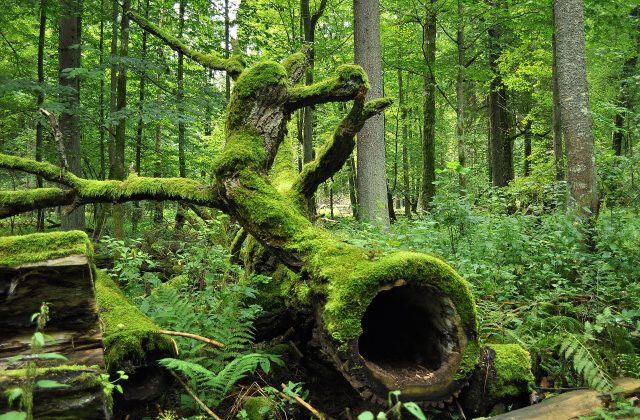
Białowieża is the last large remnant of the primeval lowland forest that once covered the European plain, on…
3 tickets & tours
Poland
The Slowinski National Park lies on the Baltic coast of northern Poland, in Pomerania, midway between the ports of…
2 tickets & tours
Poland
Wolin is the largest island of Poland, lying in the far north-western corner of the country between the Baltic and the…
1 ticket or tour
Poland
The Biebrza marshes lie in the north-east of Poland, in the region of Podlasie, along a lazy, unregulated river that…
No online ticket
Poland
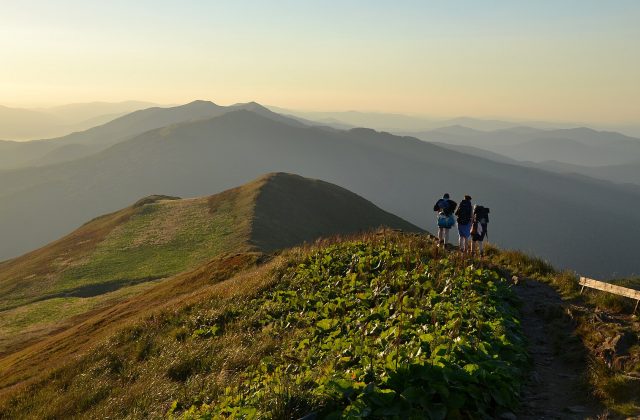
The Bieszczady are the wildest and emptiest mountains in Poland, in the extreme south-eastern corner of the country,…
No online ticket