Tijuca National Park
Brazil
Tijuca is the rainforest inside the city of Rio de Janeiro, and it is visited on half-day and full-day tours from the…
30 tickets & tours
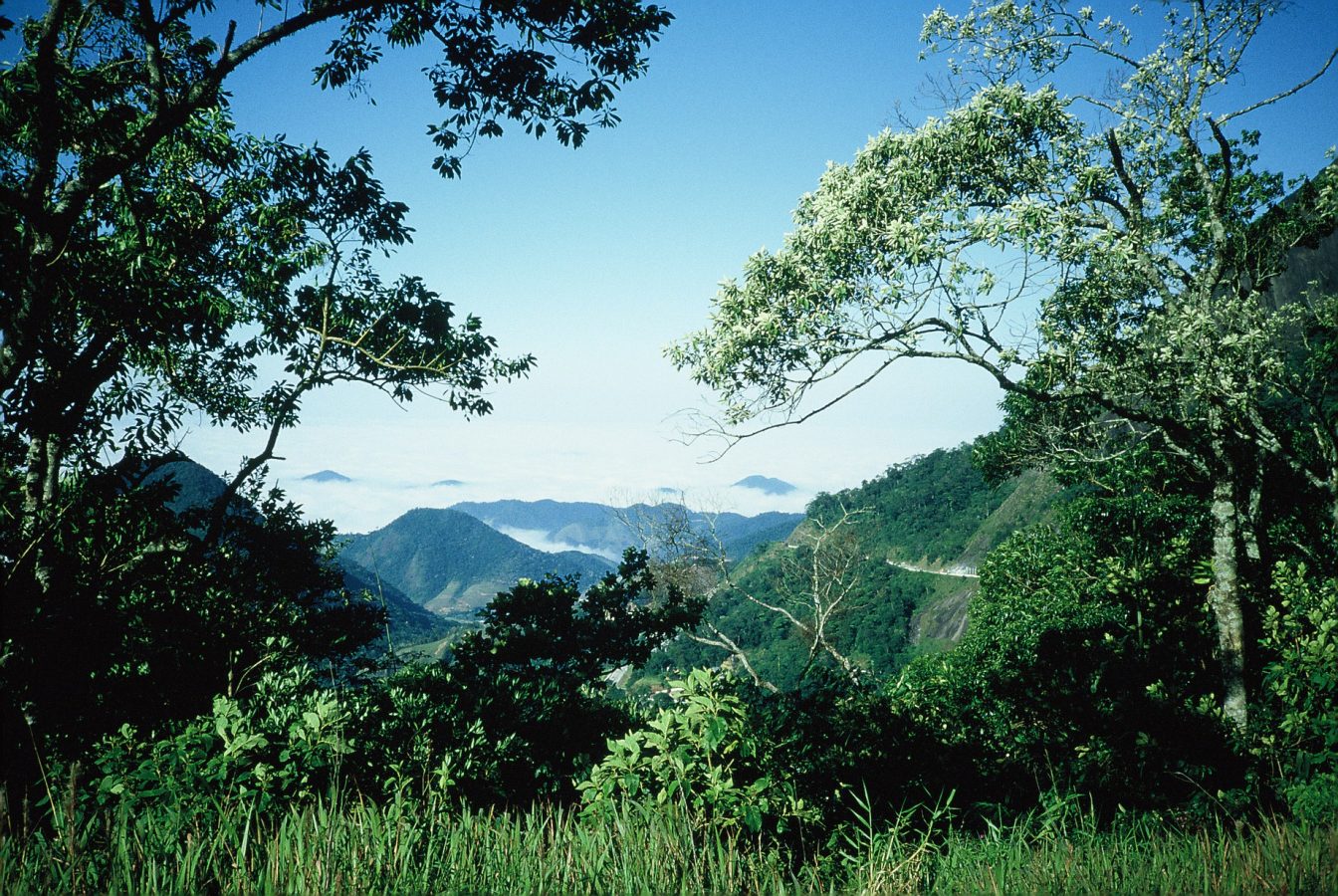
The Serra da Bocaina is a section of the great coastal escarpment of south-eastern Brazil, the Serra do Mar, on the border of the states of Rio de Janeiro and Sao Paulo, and its national park runs from the summits, above two thousand metres, down to the sea beside the colonial port of Paraty, which is about four hours by road from Rio and four and a half to five from Sao Paulo. It is a large, thinly staffed park with little in the way of facilities, and it is approached from two quite different sides. Most foreign visitors meet it from below, from Paraty. Twenty-five kilometres south of the town, the fishing and surfing village of Trindade lies at the park's edge, and from its last beach a forest path of twenty minutes leads to the Caixa d'Aco, a natural swimming pool enclosed by huge granite boulders at the sea's edge;
agencies in Paraty offer guided hikes in the forest above the town, to waterfalls, to old stretches of the gold road, and up to the Pedra da Macela, a viewpoint at 1,840 metres reached from the road to Cunha by a steep paved track of two kilometres, from which the whole bay of Ilha Grande, with its hundreds of islands, is seen at sunrise. The official entrance is on the other, inland side, on the plateau: from the small town of Sao Jose do Barreiro, in the Paraiba valley, a rough road of twenty-seven kilometres, requiring a four-wheel drive, climbs to the park gate, near which are the waterfalls of Santo Izidro and the simple mountain inns where trekkers gather. From there begins the celebrated Gold Trail, a walk of three days, about fifty kilometres, down through the forest to the coast at Mambucaba, done with a local guide and nights at farmhouses. Visits beyond the gate area are registered with the park office.
Live dates and prices from GetYourGuide. Free cancellation on most tickets.
The park was created in 1971 and covers about 104,000 hectares, rising from sea level to 2,088 metres at the Pico do Tira Chapeu, the peak that takes one's hat off, and it is one of the largest protected tracts of the Atlantic Forest, the rainforest that once covered the whole coast of Brazil and of which less than an eighth survives, in fragments, richer in species found nowhere else than even the Amazon. Since 2019 it has been one of the four natural components of the World Heritage Site of Paraty and Ilha Grande, inscribed for both culture and biodiversity. The range of altitude gives it a complete sequence of vegetation: coastal forest with palms and giant figs, dense montane rainforest loaded with bromeliads, orchids, ferns and lianas, cloud forest, stands of the candelabra-shaped Parana pine, and, on the rolling summit plateau, natural high-altitude grasslands with many plants of their own. The animals include the southern muriqui, or woolly spider monkey, the largest primate of the Americas and one of the most endangered, which lives in peaceful, embracing troops, the brown howler, the black-horned capuchin, the buffy-tufted marmoset, the jaguar, in very small numbers, the puma, the ocelot, the tapir, the maned sloth, the paca and the otter, and among some three hundred species of birds are the black-fronted piping guan, the saffron toucanet, the red-breasted toucan, the bare-throated bellbird, whose metallic call rings through the forest, the vinaceous parrot and many hummingbirds and tanagers.
The park's human history is that of a road. When gold was discovered in Minas Gerais at the end of the seventeenth century, the only authorised route to the coast was an old track of the Guaiana Indians over these mountains to Paraty, whence the metal was shipped to Rio and Lisbon; the crown had it paved by slaves with great irregular blocks of stone, with drains and retaining walls, to bear the mule trains, and for a few decades Paraty was one of the richest ports of the empire, until a more direct road to Rio, opened in the 1720s, put it to sleep, which is why the town survived intact. In the nineteenth century the same trails carried coffee down from the Paraiba valley and slaves, landed illegally on the beaches after the trade was banned, up to the plantations. Long stretches of the stonework survive under the forest. Within the park are rivers with dozens of waterfalls, among them the Cachoeira do Veado, which descends about two hundred metres in steps on the second day of the Gold Trail. Hunting, the cutting of palm hearts and the unresolved land titles of families living inside the boundary are its chronic problems.
The park can be visited all year, but the seasons differ sharply. The southern winter, from May to September, is the dry season and the best for walking: days are clear, rivers low, and the views from the plateau and the Pedra da Macela at their best, though nights on the top are cold, with frost, and the sea at Trindade is cool. The summer, from November to March, is hot and very wet, this being one of the rainiest stretches of the Brazilian coast, with violent afternoon storms, swollen rivers that make the Gold Trail's fords dangerous, landslides on the mountain roads, mud, mosquitoes and mist on the summits, though the waterfalls are full and the beaches warm;
Brazilian holidays, from Christmas to Carnival, crowd Trindade. Take a guide for anything beyond the short paths, since trails are unmarked, and carry waterproofs, repellent and cash. Allow a day from Paraty, four for the Gold Trail. Paraty's historic centre is the base, Ilha Grande two hours east, and Cunha, with its potters, an hour inland.
Yes. GetYourGuide lists one ticket or tour for Serra da Bocaina National Park, with live dates and prices and free cancellation on most of them.
Allow a day from Paraty, four for the Gold Trail.
Serra da Bocaina National Park covers 1 066 km².
Serra da Bocaina National Park was established in 1971.
Serra da Bocaina National Park is in Brazil. The map on this page shows the exact spot.
Brazil
Tijuca is the rainforest inside the city of Rio de Janeiro, and it is visited on half-day and full-day tours from the…
30 tickets & tours
Brazil
Lençóis Maranhenses is the field of white dunes and rainwater lagoons on the coast of Maranhão in north-eastern Brazil,…
12 tickets & tours
Brazil
Iguaçu National Park is the Brazilian side of the falls at Foz do Iguaçu, and its visit is one walk: the entrance…
9 tickets & tours
Brazil
The Serra dos Órgãos is the mountain range that closes the northern horizon of Guanabara Bay, whose granite needles are…
5 tickets & tours
Brazil
The Chapada Diamantina is a range of table mountains, canyons, waterfalls and caves in the dry interior of the…
3 tickets & tours
Brazil
Itatiaia is the oldest national park in Brazil, in the Mantiqueira mountains on the border of the states of Rio de…
3 tickets & tours