Tijuca National Park
Brazil
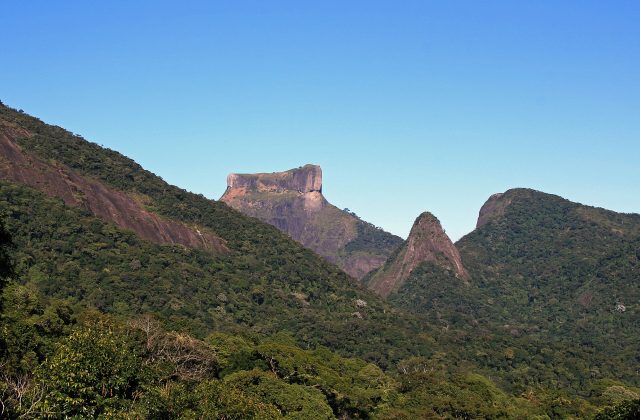
Tijuca is the rainforest inside the city of Rio de Janeiro, and it is visited on half-day and full-day tours from the…
30 tickets & tours

Photo: Thiagomarcelcampi, CC BY-SA 4.0
Serra da Capivara lies in the dry backlands of the state of Piaui, in the north-east of Brazil, one of the poorest and least visited parts of the country, and it contains the greatest concentration of prehistoric rock paintings in the Americas, in a landscape of sandstone cliffs and canyons of considerable grandeur. It is a long way from anywhere. The gateway is the town of Sao Raimundo Nonato, which has a small airport with a few flights a week from Recife and Petrolina, and is otherwise reached by road from Petrolina, on the Sao Francisco river, three hundred kilometres and about four hours away, which has daily flights from the large cities, or from Teresina, the state capital, a journey of seven to eight hours. The town has simple hotels, and there is a good guesthouse at the pottery cooperative on the park's edge.
The park has four entrances, of which the nearest lies about twenty-five kilometres from the town, and entry is permitted only with an accredited local guide, who is hired by the day through the hotels or the guides' association, and with a vehicle, either one's own hired car or the guide's; a small entrance fee is paid at the gates. Of more than a thousand archaeological sites, some 170 have been prepared for visitors, with walkways, steps, handrails and in some cases ramps for wheelchairs, grouped into a dozen circuits, which involve short drives and easy to moderate walks, and two to three days are needed to see the principal ones: the Boqueirao da Pedra Furada, the most famous shelter, which is floodlit on certain evenings, with the pierced rock near by; the Baixao das Andorinhas, where thousands of swifts dive into a canyon at dusk; the Desfiladeiro da Capivara; the Serra Branca, with a long series of painted shelters; and the viewpoints along the escarpment. In Sao Raimundo Nonato, the Museum of American Man and the newer Museum of Nature, beside the park, are excellent and should be seen first.
The national park was created in 1979, covers about 1,300 square kilometres, and was inscribed as a World Heritage Site in 1991. It occupies the edge of a sandstone plateau, which breaks off to the south and east in a line of cliffs up to two hundred and seventy metres high, deeply indented by canyons and ravines, called boqueiroes, and eroded into towers, arches and overhangs, the rock red, orange and grey. In the shelters at the foot of these cliffs, over a period of many thousands of years, people painted, in red ochre chiefly, with yellow, white, grey and black, tens of thousands of figures, often very small and drawn with great liveliness: deer, rheas, capybaras, jaguars, armadillos, lizards and crabs, human figures running, hunting with spear throwers, dancing in lines, fighting, embracing, giving birth and having sex, figures gathered round a tree, and enigmatic scenes, such as two people back to back, which has become the emblem of the park. Archaeologists distinguish several traditions, the oldest of which is dated to about twelve thousand years ago and perhaps much more. The park owes its existence, its museums and its fame to one woman, the Franco-Brazilian archaeologist Niede Guidon, who first saw photographs of the paintings in 1963, began excavating here in 1973, persuaded the government to create the park, founded the institution that manages it jointly with the state, and lived beside it until her death in 2025. Her claims made the place a battleground of science.
At the Boqueirao da Pedra Furada she excavated, beneath the painted wall, deep layers containing charcoal and chipped stones, which she interpreted as hearths and tools, with dates going back thirty, fifty and even a hundred thousand years, at a time when the accepted view was that people had entered the Americas no more than thirteen thousand years ago; most North American archaeologists rejected the evidence, arguing that the fires were natural and the stones broken by falling from the cliff, or, as one study suggested, by capuchin monkeys, which here use stones as tools, but later excavations at neighbouring sites have produced further early dates, and the question remains open. The region was much wetter then, and the bones of giant ground sloths, mastodons, sabre-toothed cats and huge armadillos have been found in its caves and lagoons. Today it is the heart of the caatinga, the white forest, a thorny, drought-adapted scrub of cacti, bromeliads and small trees, found only in north-eastern Brazil, which sheds its leaves and turns grey and apparently lifeless for the eight dry months of the year, and bursts into green within days of the first rain. It shelters jaguars, pumas, ocelots, giant anteaters, the rock cavy, which is confined to this region, armadillos, capuchin monkeys, rheas and more than two hundred species of birds. The project has also tried to give the surrounding villages, among the poorest in Brazil, a living, through schools, a pottery that reproduces the rock art motifs, beekeeping and employment as guides and guards, though it has been chronically short of funds.
The park is open daily from early morning until late afternoon. The climate is semi-arid and hot throughout the year, with daytime temperatures of 30 to 38 degrees. The rainy season, which is short and unreliable, falls between about December and April, when the caatinga is green and in flower, the air is fresher and the heat a little less, but some tracks may be muddy; the long dry season, from May to November, is the more usual time to visit, with clear skies and easier driving, the months from June to August being the least hot, with cool nights, and September to November the hottest and driest, when the landscape is grey and bare.
The paintings are best seen and photographed in the soft light of early morning and late afternoon, and the middle of the day is for the museums and a siesta. Carry plenty of water, a hat and sunscreen, and wear closed shoes. Book the guide a day or more ahead, especially in the Brazilian holidays in July and at the New Year. Allow three days. The Serra das Confusoes park, wilder and larger, lies two hours to the west.
No online tour for Serra da Capivara National Park is listed on GetYourGuide; entry, where it is charged, is paid at the gate or through the park authority. Nearby parks with bookable tours are listed on this page.
The park is open daily from early morning until late afternoon.
Serra da Capivara National Park covers 1 300 km².
Serra da Capivara National Park was established in 1979.
Serra da Capivara National Park is in Brazil. The map on this page shows the exact spot.
Brazil
Tijuca is the rainforest inside the city of Rio de Janeiro, and it is visited on half-day and full-day tours from the…
30 tickets & tours
Brazil
Lençóis Maranhenses is the field of white dunes and rainwater lagoons on the coast of Maranhão in north-eastern Brazil,…
12 tickets & tours
Brazil
Iguaçu National Park is the Brazilian side of the falls at Foz do Iguaçu, and its visit is one walk: the entrance…
9 tickets & tours
Brazil
The Serra dos Órgãos is the mountain range that closes the northern horizon of Guanabara Bay, whose granite needles are…
5 tickets & tours
Brazil
The Chapada Diamantina is a range of table mountains, canyons, waterfalls and caves in the dry interior of the…
3 tickets & tours
Brazil
Itatiaia is the oldest national park in Brazil, in the Mantiqueira mountains on the border of the states of Rio de…
3 tickets & tours