Tijuca National Park
Brazil
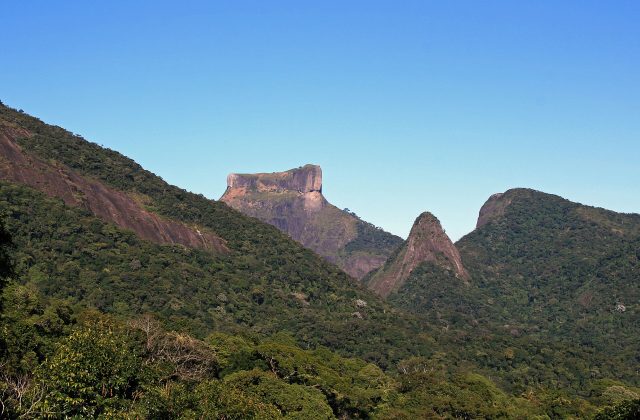
Tijuca is the rainforest inside the city of Rio de Janeiro, and it is visited on half-day and full-day tours from the…
30 tickets & tours

Photo: Andreza Oliveira Borges, CC BY-SA 3.0
Emas is a park of open grassland in the far south-west of the state of Goias, in the centre of Brazil, where that state meets Mato Grosso do Sul and Mato Grosso, and it is the best place in South America to see the large animals of the savanna, the giant anteater, the maned wolf and the rhea, in an open landscape where they can actually be found. It is a long way from anywhere, and few foreigners come except with specialised wildlife operators: the nearest large airports are Goiania, some five hundred kilometres and six to seven hours by road, and Campo Grande, about the same distance, and the two small farming towns that serve as gateways are Chapadao do Ceu, twenty-six kilometres from the main gate, and Mineiros, eighty-five kilometres from another, both with modest hotels.
Entry is controlled by the federal parks institute, and every visit must be accompanied by an accredited local guide, who is engaged through the tourism offices or agencies of those towns and who usually brings a suitable vehicle, since the park has no transport of its own. The visit is, in effect, a safari: one drives slowly, at dawn and in the late afternoon, along the network of straight earth roads, which double as firebreaks, that cross the grassland, standing in the back of a pickup, scanning for anteaters shuffling through the grass, deer, rheas and the occasional wolf or cat, with stops at viewpoints and at short walking trails through gallery forest to clear streams. On the Formoso river, which rises in the park, local operators offer gentle rafting and floating with a mask in transparent water. There is no accommodation or restaurant inside, only a simple visitor centre and campsite near the gate. At the right time of year, guides lead night visits to see the glowing termite mounds, which are the park's most famous spectacle.
The national park was created in 1961 and covers about 1,320 square kilometres of a gently rolling plateau at 800 to 900 metres, and in 2001 it was inscribed, together with the Chapada dos Veadeiros, as a World Heritage Site representing the cerrado. The cerrado, the savanna that once covered a fifth of Brazil, exists in many forms, from closed woodland to treeless prairie, and Emas is the largest protected area of its most open types, the clean and dirty fields, vast expanses of native grasses with scattered shrubs and small twisted trees, broken by ribbons of forest and lines of buriti palms along the watercourses. Its name means rheas, after the big flightless birds, relatives of the ostrich, which stalk about the plains in groups. The streams that rise here flow to three of the great river systems of the continent, the Amazon, by way of the Araguaia, the Plate, by way of the Parana, and the Pantanal, by way of the Taquari. The park is, however, an island. Since the 1970s the surrounding plateau, which has deep, level soils ideal for machines, has been converted almost entirely to soya, maize, cotton and sugar cane, right up to the boundary fence, and the park's animals are isolated, exposed to pesticide drift, and killed on the roads when they wander out. Within it, life revolves round two things, termites and fire.
The grassland is studded with termite mounds, grey, rock-hard towers a metre or two high, estimated at many millions, which shelter not only termites but owls, parakeets, snakes and lizards, and feed the giant anteater, which is more abundant and more easily watched here than perhaps anywhere else, and the giant armadillo. In the outer layer of the mounds live the larvae of a click beetle, which on warm, humid, moonless nights at the beginning of the rainy season switch on a bright green light to attract the winged termites and ants then swarming, which they seize and eat; a mound may carry hundreds of these points of light, and a field of them looks like a city seen from the air. Lightning sets the dry grass alight every few years, and the vegetation is adapted to it, resprouting within days and flowering in profusion, which draws the grazers; but fires entering from the farms have at times burned almost the whole park at once, as in 2005 and 2010, and a system of burnt firebreaks is now maintained. The fauna includes the maned wolf, a tall, red, long-legged, solitary canid that eats as much fruit as flesh, the pampas deer, the marsh deer, tapirs, peccaries, pumas, jaguars, the bush dog, and among more than 350 species of birds the blue-and-yellow macaw, the red-legged seriema, the greater rhea, the yellow-faced parrot, the white-winged nightjar and the cone-billed tanager, a bird known from a single specimen until it was rediscovered here in 2003.
The park is open all year, but what can be seen depends strongly on the season. The dry season, from about May to September, is the best for mammals: the grass is short, particularly where it has been burned, the skies are clear, the roads firm, and anteaters and wolves are active by day in the cool weather, the nights in June and July falling to five degrees or lower. The glowing termite mounds can be seen only for a few weeks at the onset of the rains, generally from late September or October to November, on hot, still, damp nights after the first showers, and cannot be guaranteed.
From December to March it rains heavily, the grass grows tall and hides the animals, the tracks become muddy, and birds are breeding. The sun on the open plateau is fierce and there is no shade, so bring a hat, sunscreen, water, warm layers for the dawn drive in winter, binoculars and repellent. Book the guide ahead. Allow two to three full days. The Pantanal and Bonito are a day's drive to the west.
No online tour for Emas National Park is listed on GetYourGuide; entry, where it is charged, is paid at the gate or through the park authority. Nearby parks with bookable tours are listed on this page.
The park is open all year, but what can be seen depends strongly on the season.
Allow two to three full days.
Emas National Park covers 1 326 km².
Emas National Park was established in 1961.
Emas National Park is in Brazil. The map on this page shows the exact spot.
Brazil
Tijuca is the rainforest inside the city of Rio de Janeiro, and it is visited on half-day and full-day tours from the…
30 tickets & tours
Brazil
Lençóis Maranhenses is the field of white dunes and rainwater lagoons on the coast of Maranhão in north-eastern Brazil,…
12 tickets & tours
Brazil
Iguaçu National Park is the Brazilian side of the falls at Foz do Iguaçu, and its visit is one walk: the entrance…
9 tickets & tours
Brazil
The Serra dos Órgãos is the mountain range that closes the northern horizon of Guanabara Bay, whose granite needles are…
5 tickets & tours
Brazil
The Chapada Diamantina is a range of table mountains, canyons, waterfalls and caves in the dry interior of the…
3 tickets & tours
Brazil
Itatiaia is the oldest national park in Brazil, in the Mantiqueira mountains on the border of the states of Rio de…
3 tickets & tours